
Evidence Check
Does creatine do anything if you don't train?
What the published research shows about creatine for muscle, memory, mood and brain disease in people who do not exercise.
At a glance
- Background
- Creatine is a compound that the body makes and stores, mostly in muscle, as a reserve of quick energy. Researchers have studied it for more than 30 years, mainly in people who train. It is now also being tested for memory, mood and brain disease. In 2026, a trial reported that people gained lean mass on creatine without exercise, and that result came from 13 people on creatine.
- Purpose
- This article checks what the published research shows about creatine in people who do not exercise. It also shows how strong that evidence is.
- What the evidence shows
- Shown. Creatine treats two rare inherited conditions in which the body cannot make it. Promising but small. One small trial found better test scores after a night without sleep, at one very large dose. Small trials also found a benefit in depression when creatine was added to treatment, but confidence in that result is very low. Tested, no clear benefit. The larger trials found no clear gain in muscle or memory in people who do not exercise. Two large trials also found that creatine did not slow Parkinson's or Huntington's disease.
- What this means for you
- If you do not exercise, the evidence gives no reason to expect a noticeable change in your body or your thinking from creatine. Its clear benefit comes with weight training.
In this article
What is creatine?
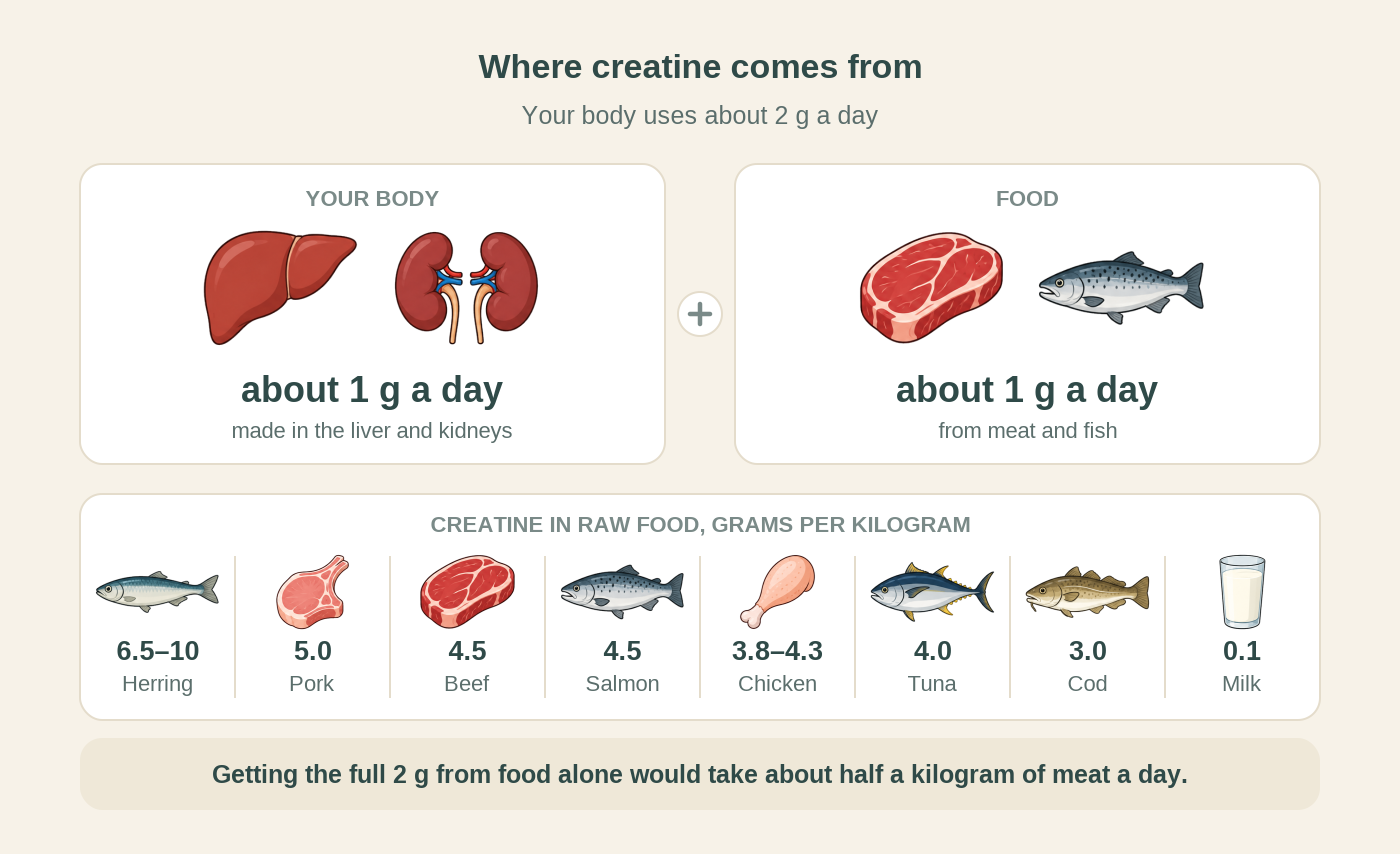
Creatine is a compound made from three amino acids, the building blocks of protein. Your body makes creatine, mainly in the liver and kidneys. You also get creatine from food, mostly from meat and fish. About 95% of the creatine in your body is stored in your muscles, with smaller amounts in the brain and heart.
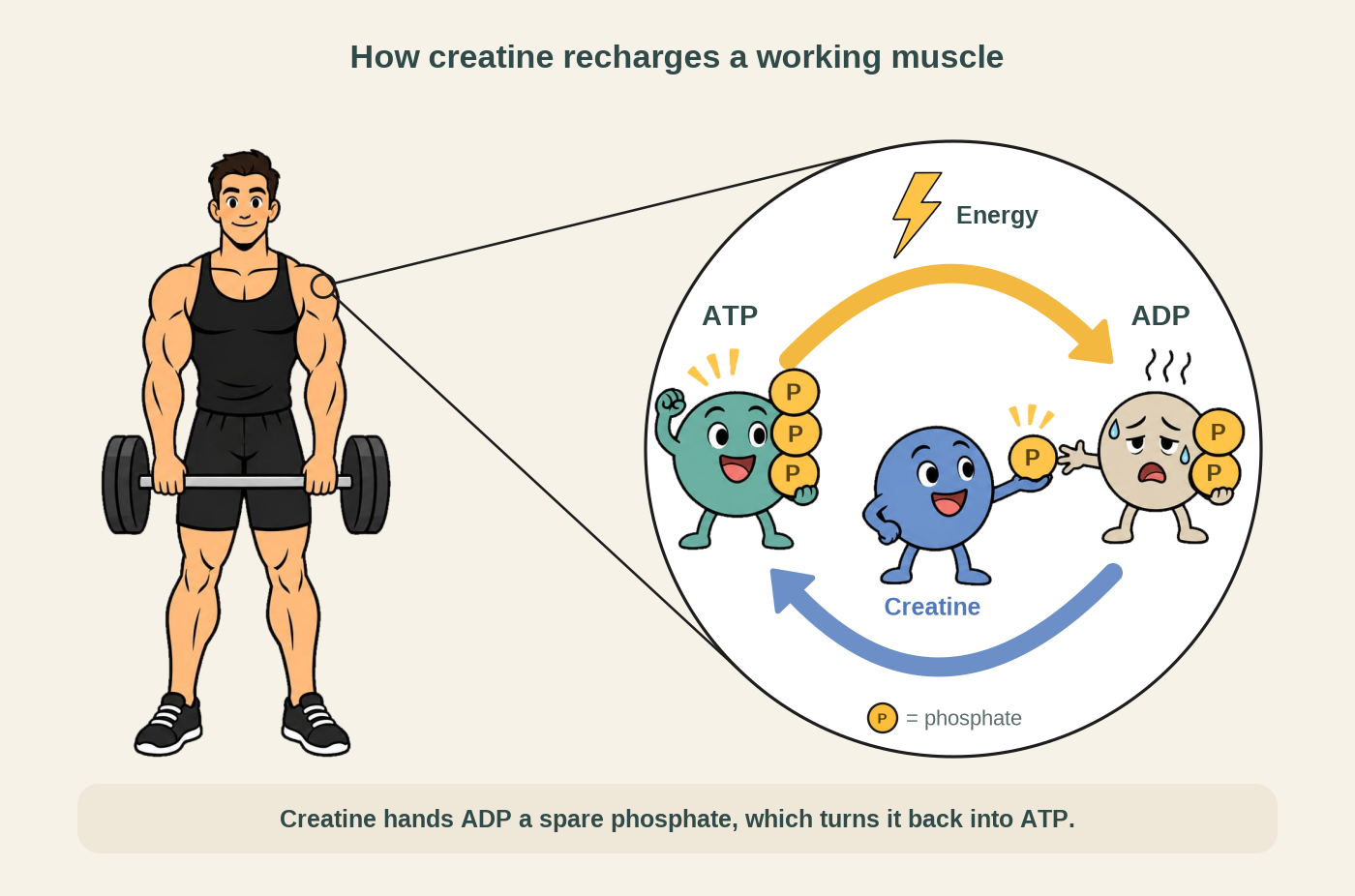
Most of what a cell does is paid for with ATP, a molecule that carries three phosphates. When the cell needs energy, ATP gives up one phosphate, and that releases the energy the cell uses. What is left is ADP, which has two phosphates. Think of ADP as a flat rechargeable battery. When it gets a third phosphate back, it becomes ATP again.
This is where creatine comes in. Much of the creatine in your muscles holds a spare phosphate. The moment ATP is spent, creatine hands over its spare phosphate to the remaining ADP, quickly converting it back into ATP. The cell has other ways to rebuild ATP, such as burning carbs or fats, but all of them are slower. Creatine's handover is the fastest (Figure 1).
That speed matters most when you demand maximum effort all at once, like in a sprint, a jump, or a heavy lift. During those bursts, your muscles burn through ATP faster than slower systems can replace it, so your creatine reserve steps in to bridge the gap. When the effort eases, creatine picks up a new phosphate and the reserve refills.
A supplement of creatine monohydrate, the most extensively studied form, puts more creatine into the muscle, making the reserve larger. This is why people take creatine for sports built on short, hard efforts and to get more out of lifting weights.
Your body uses about 2 grams of creatine a day and has to replace it. It makes roughly half and takes the rest from food. Getting the full 2 grams from food alone would take about half a kilogram of meat a day (Figure 2), so a supplement is the practical way to raise the body's stores. Three grams a day fills the muscles' stores in about four weeks. A fuller reserve helps most when demand is highest, and that is where creatine's clearest benefits show up.
What happens when your body does not have enough creatine?
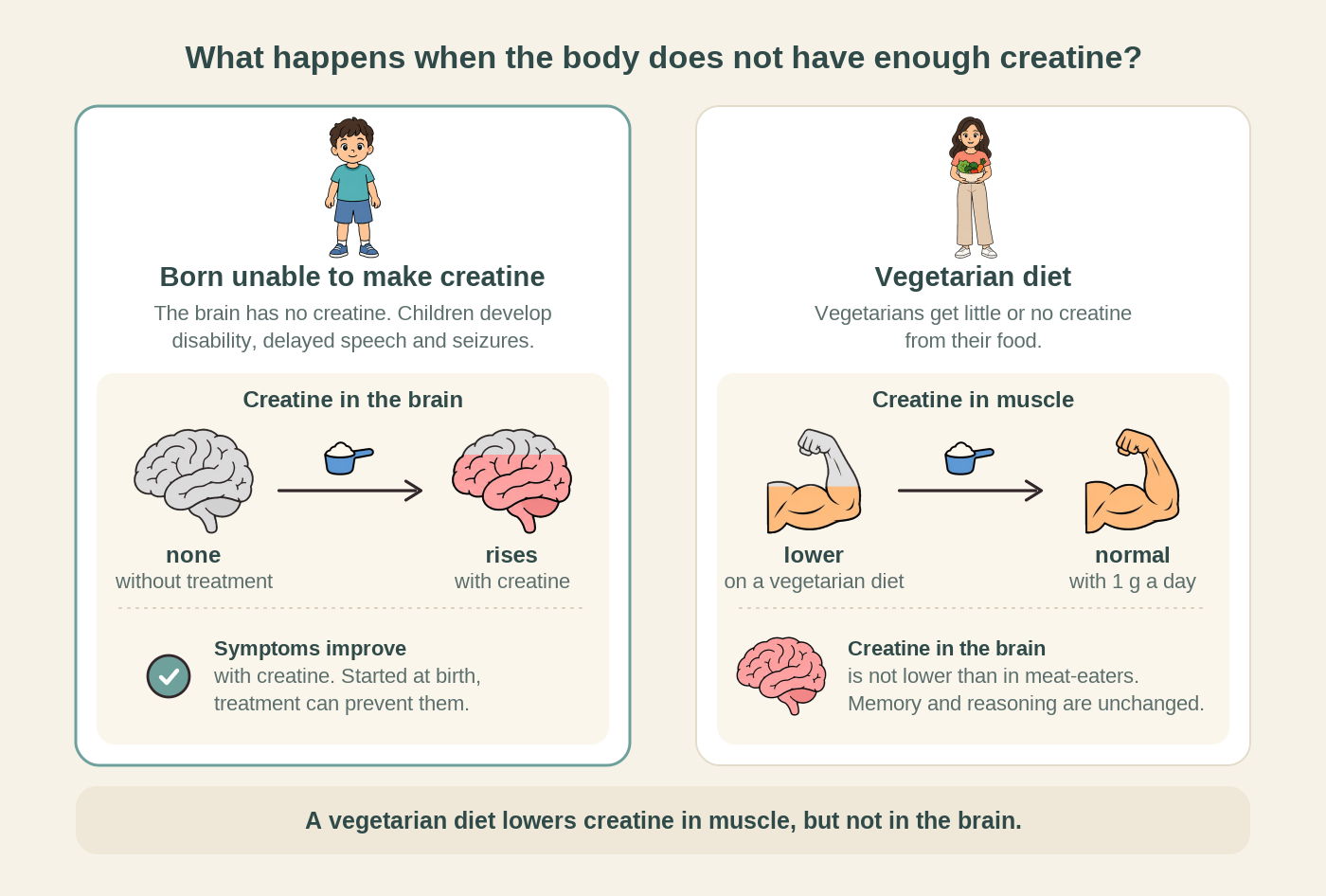
Two groups of people help answer that question. The first group is people who are born unable to make creatine. The second group is vegetarians, who get little or no creatine from their food.
The first group has one of two rare inherited conditions, known as GAMT and AGAT deficiency. Their bodies lack an enzyme needed to make creatine, so their brains have none. Without treatment, children develop intellectual disability and delayed speech, and many also have autism-like behavior and seizures. Creatine supplements raise the amount in the brain and improve symptoms. Starting treatment at birth can prevent the symptoms altogether. A 2019 review calls this the clearest medical use of creatine. Because these conditions are so rare, the evidence comes from individual cases and small groups of children, not from large trials.
Vegetarians and vegans are a much milder case. They get little or no creatine from food. As a result, they have less creatine in their blood and muscles than people who eat meat. One study shows the effect of diet clearly. Forty women changed to a vegetarian diet for six months, and the amount of creatine in their blood and muscles went down. Taking 1 gram of creatine a day corrected this drop.
It is a separate question whether these lower stores change how the brain works. Two earlier studies reported that vegetarians had better memory or reasoning after taking creatine. Researchers at the University of Bonn in Germany ran the largest trial on this question and published it in 2023. Their trial did not confirm those results. They gave 123 adults 5 grams of creatine a day for six weeks and a placebo for another six weeks, in random order. About half of the adults were vegetarian. Across the whole trial, creatine made no clear difference to memory or reasoning, and the result was the same for vegetarians and meat-eaters (Figure 3).
Most research on creatine has studied people who train, and that is where its benefit is best measured. Creatine is now also promoted to people who do not exercise. The rest of this article looks at whether you can benefit from creatine if you do not actively train.
Can you build muscle just by taking creatine?
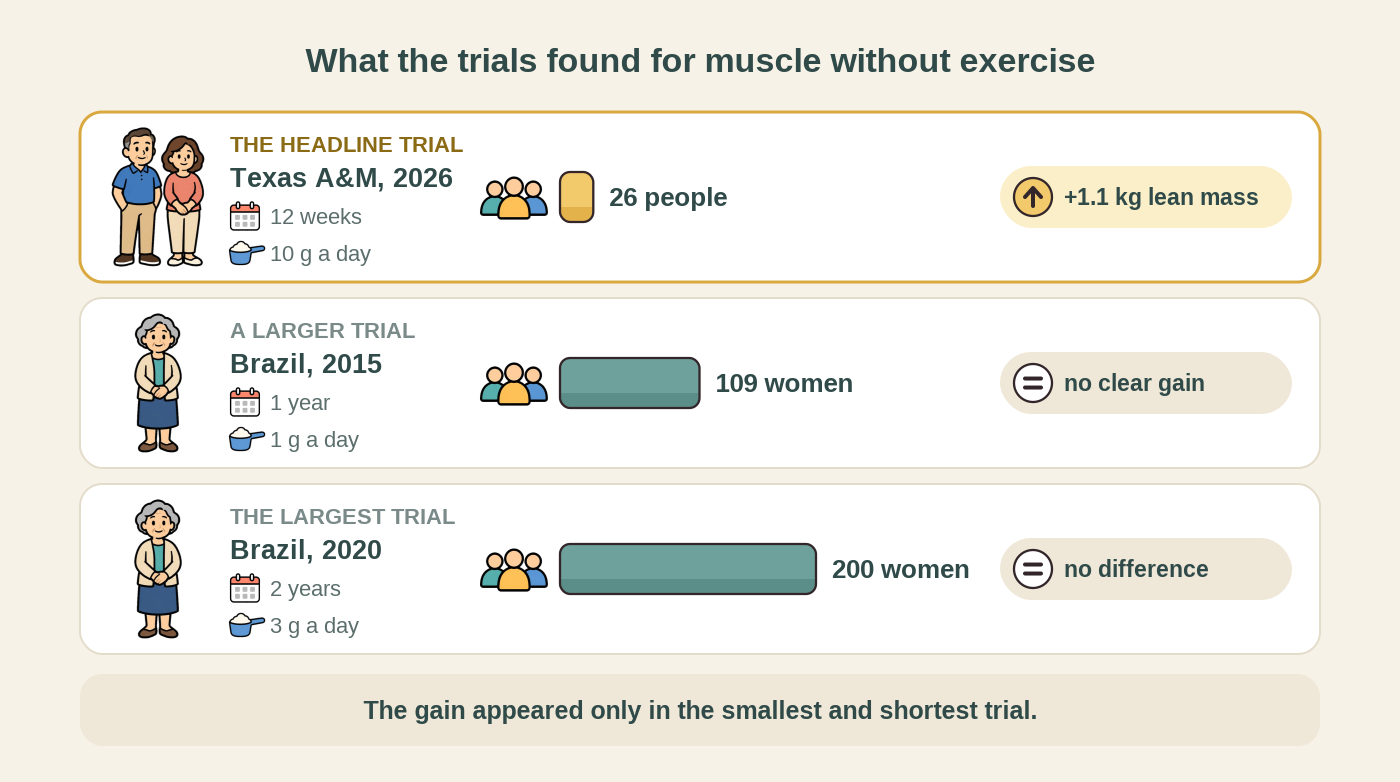
The claim that creatine alone can build muscle comes from a trial published in 2026 by researchers at Texas A&M University. The study was done on 73 adults aged 45 to 65 who did little exercise. It was a controlled study, and the creatine group took 10 grams a day for 12 weeks. Among those who did not exercise, 13 took creatine and 13 took the placebo. The people on creatine gained about 1.1 kilograms of lean mass. They could also lift slightly more weight on the bench press.
Larger studies have not found the same thing, although none has repeated this exact trial. A 2024 pooled analysis combined the results of 143 trials. With weight training, creatine added about 1 kilogram of lean mass. In people who did not exercise, it added 0.24 kilograms, which is small enough to be chance. The largest trial without exercise in that analysis was published in 2015 by researchers in Brazil. It enrolled 109 women past menopause who had thinning bones. Of these, 56 took 1 gram of creatine a day and 53 took a placebo, for one year. Lean mass did not differ clearly between the two groups.
The same research group in Brazil published a second, larger study in 2020. It enrolled 200 women who were also past menopause with thinning bones. Of these, 106 took 3 grams of creatine a day and 94 took a placebo, for two years. Lean mass rose in both groups over the two years, and creatine made no difference. Grip strength and the walking and chair-rise tests also showed no difference between the groups (Figure 4). Both Brazilian trials used lower doses than the 2026 trial, which gave 10 grams a day.
Can creatine improve memory and focus?
The brain holds creatine and uses the same energy system as muscle. Children who cannot make creatine are severely affected, as described above. The question here is whether a healthy brain gains anything from extra creatine when it already has its usual store.
The first difficulty is getting creatine into the brain. In 2024, the European Union's food-safety authority reviewed the evidence. It found that creatine rose in some brain areas after people took about 20 grams a day for one to four weeks. A normal daily dose is 3 to 5 grams, so that amount is four or more times higher.
The second difficulty is the trials themselves. The memory claim spread in 2022, when a pooled analysis of eight small trials reported a benefit. Two researchers in Brazil then pointed out that the analysis had counted some participants more than once. The authors ran it again and counted each person once, and the overall benefit was no longer clear. A benefit remained in older adults, but it rests on two small trials with 57 people in total.
The largest trial is the Bonn trial described earlier, which tested 123 adults. Reasoning did not change on creatine. Memory improved slightly, but the improvement could be chance.
Can creatine help with sleep loss, depression or brain disease?
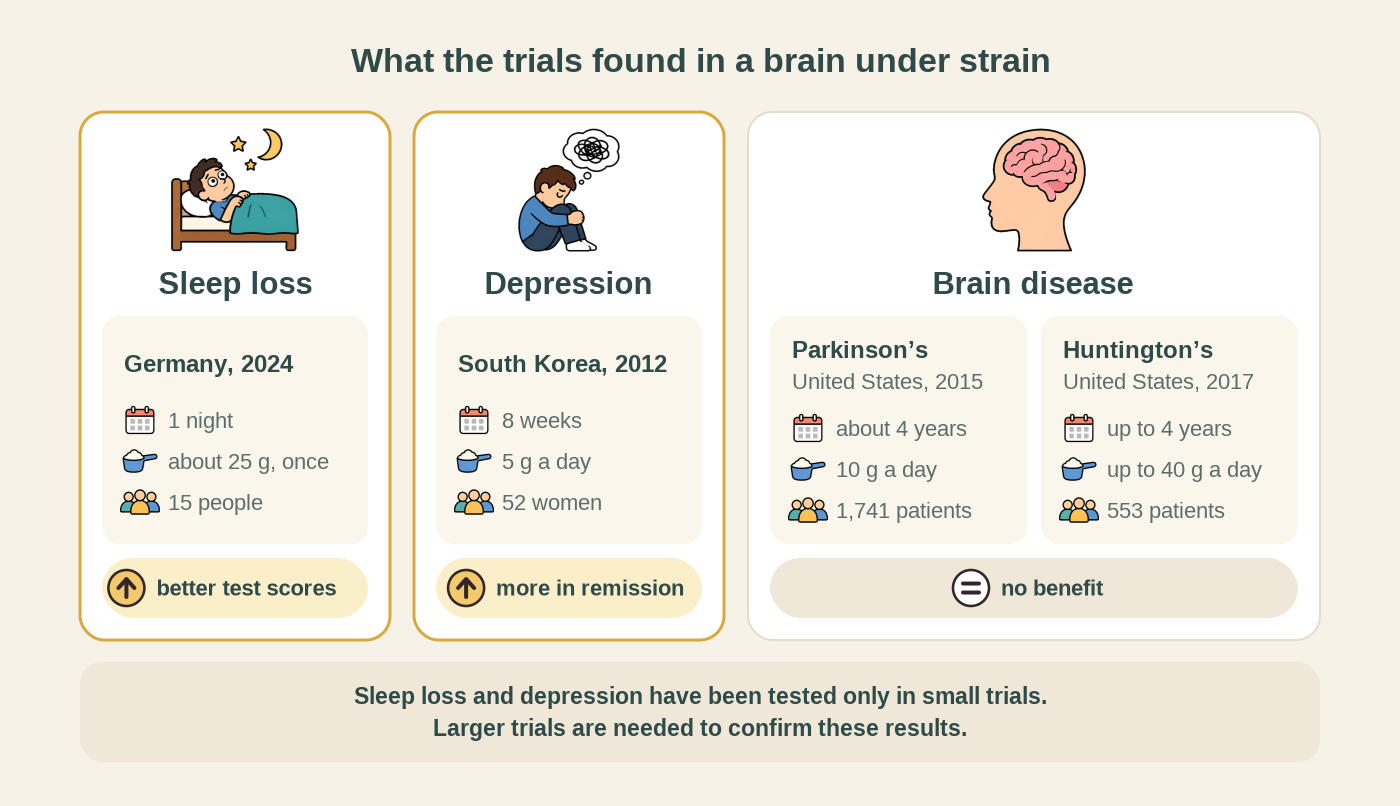
A brain under strain is a different question. Strain can leave the brain short of energy, and extra creatine might help to fill that gap. Three cases have been tested, and the results differ (Figure 5).
- Sleep loss. A German study in 2024 kept 15 young adults awake for 21 hours on two nights. On one night they took a single large dose of creatine, and on the other night they took a placebo. The dose was about 25 grams, which is five or more times a normal daily dose. On the creatine night they did better on memory and speed tests.
- Depression. Brain scans have found changes in how the brain handles energy in some people with depression. A South Korean trial in 2012 gave creatine or a placebo to 52 women who were taking an antidepressant. After eight weeks, 52% of the women on creatine were in remission, compared with 26% of those on the placebo. Remission means that their symptoms had largely gone. A 2025 pooled analysis of 11 trials found a smaller effect, about 2 points on a 52-point scale. UK guidelines count 3 points as the smallest difference that matters to patients, and the authors rated their confidence in the result as very low.
- Brain disease. After promising studies in animals, two large trials tested creatine in more than 2,200 patients. The Parkinson's trial gave 10 grams a day to 1,741 people, and the Huntington's trial gave up to 40 grams a day to 553 people. Both trials were stopped early because creatine was not slowing the disease. In the Parkinson's trial, depression scores were also no better on creatine than on the placebo.
So, does creatine do anything if you don't train?
For people who do not train, the trials show little benefit so far. Creatine is a proven supplement for one purpose. When it is added to weight training, it produces a small gain that can be measured. Without training, the evidence falls into three groups, which are shown from strongest to weakest in Figure 6.
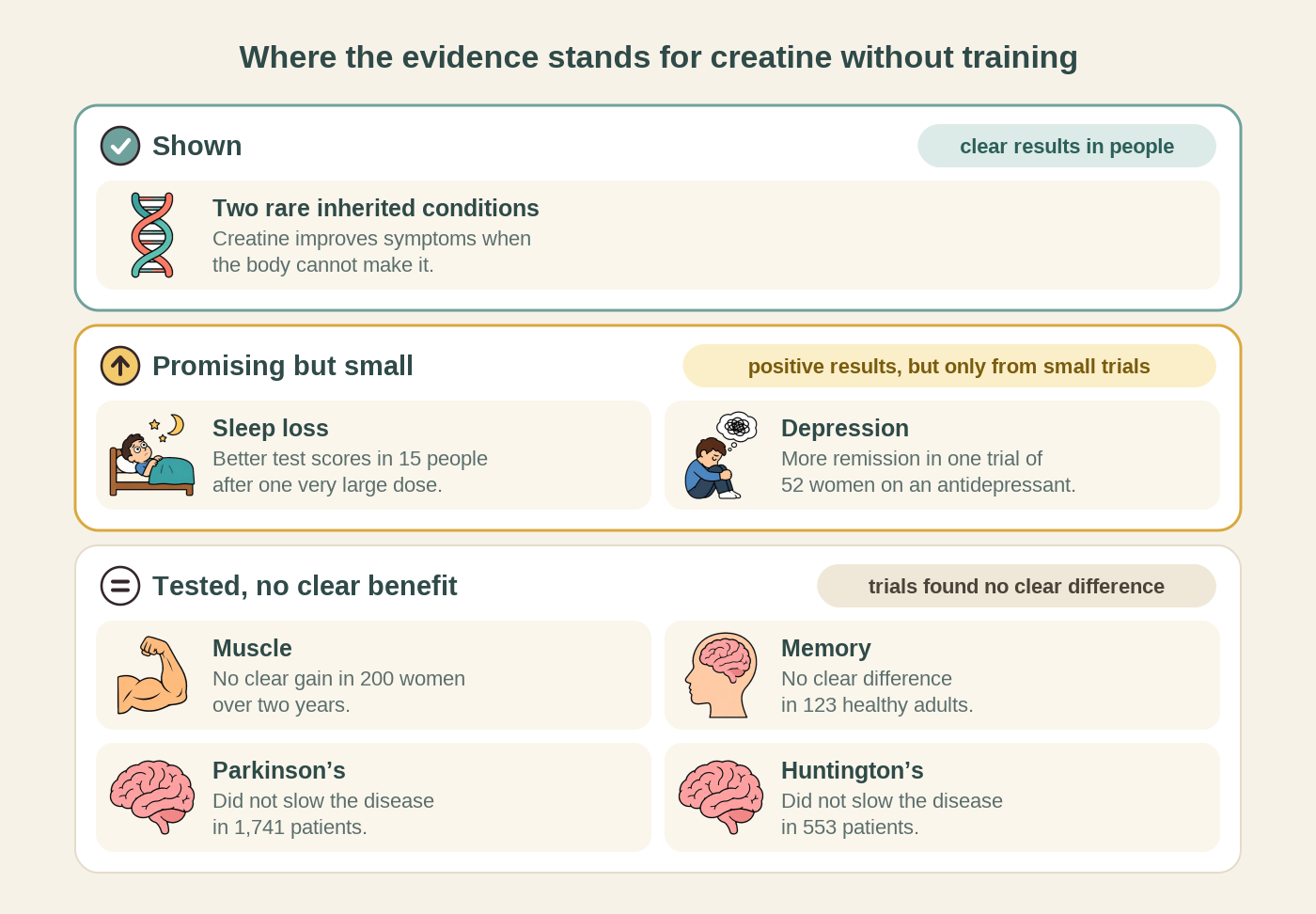
The claim that creatine builds muscle without exercise rests on one small trial. The results for sleep loss and depression are promising, but they also come from small trials that larger trials have not yet confirmed.
Creatine has a good safety record so far. In the trials described here, serious side effects were no more common on creatine than on the placebo, and the most common complaint was an upset stomach. For people who do take creatine, creatine monohydrate is the most studied form. The International Society of Sports Nutrition gives the usual dose as 3 to 5 grams a day.
This article is for information only and is not medical advice.
References
- EFSA Panel on Nutrition, Novel Foods and Food Allergens (NDA). Creatine and improvement in cognitive function: evaluation of a health claim pursuant to Article 13(5) of Regulation (EC) No 1924/2006 . EFSA J , 2024. (Regulator scientific opinion.)
- Balestrino M, Adriano E. Beyond sports: efficacy and safety of creatine supplementation in pathological or paraphysiological conditions of brain and muscle . Med Res Rev , 2019.
- Pashayee-Khamene F et al. Creatine supplementation protocols with or without training interventions on body composition: a GRADE-assessed systematic review and dose-response meta-analysis . J Int Soc Sports Nutr , 2024.
- Sandkühler JF et al. The effects of creatine supplementation on cognitive performance—a randomised controlled study . BMC Med , 2023.
- Chun J et al. Effects of creatine supplementation with and without exercise and diet intervention on body composition, cognitive function, and markers of health in middle-aged and older adults . J Int Soc Sports Nutr , 2026.
- Lobo DM et al. Effects of long-term low-dose dietary creatine supplementation in older women . Exp Gerontol , 2015.
- Sales LP et al. Creatine supplementation (3 g/d) and bone health in older women: a 2-year, randomized, placebo-controlled trial . J Gerontol A Biol Sci Med Sci , 2020.
- Prokopidis K et al. Effects of creatine supplementation on memory in healthy individuals: a systematic review and meta-analysis of randomized controlled trials . Nutr Rev , 2023 (online 2022). With the letter by Eckert I and Pascher E and the authors' reply , Nutr Rev , 2023.
- Gordji-Nejad A et al. Single dose creatine improves cognitive performance and induces changes in cerebral high energy phosphates during sleep deprivation . Sci Rep , 2024.
- Lyoo IK et al. A randomized, double-blind placebo-controlled trial of oral creatine monohydrate augmentation for enhanced response to a selective serotonin reuptake inhibitor in women with major depressive disorder . Am J Psychiatry , 2012.
- Eckert I et al. Creatine supplementation for treating symptoms of depression: a systematic review and meta-analysis . Br J Nutr , 2025.
- Writing Group for the NINDS Exploratory Trials in Parkinson Disease (NET-PD) Investigators. Effect of creatine monohydrate on clinical progression in patients with Parkinson disease: a randomized clinical trial . JAMA , 2015.
- Hersch SM et al. The CREST-E study of creatine for Huntington disease: a randomized controlled trial . Neurology , 2017.
- Kreider RB et al. International Society of Sports Nutrition position stand: safety and efficacy of creatine supplementation in exercise, sport, and medicine . J Int Soc Sports Nutr , 2017.
Reader discussion
Join the discussion
Ask about the evidence, point us to a study we may have missed, or tell us what was unclear. Keep the discussion respectful and avoid personal medical advice.